
The Rising Cost Challenge in Modern Logistics
If you’re managing warehouse operations or overseeing supply chain logistics in 2025, you’ve felt the squeeze. Freight rates remain volatile, warehouse space commands premium prices, and damaged goods claims eat into margins. The global air cushion packaging market is growing rapidly as businesses search for protective packaging solutions that don’t break the budget.
For logistics managers and procurement directors, the math is straightforward: every percentage point you shave off packaging costs directly improves your bottom line. Traditional air bubble films and air cushion films often force you to choose between protection and cost efficiency. What if you didn’t have to make that trade-off?
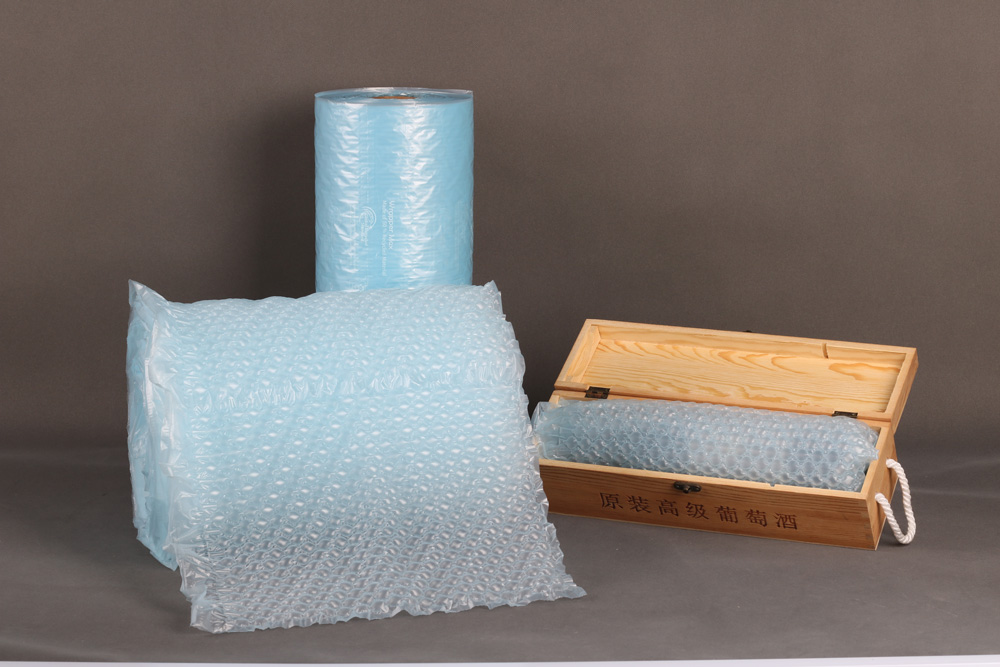
The Hidden Cost of Traditional Bubble Film
When calculating packaging costs, most operations look at the per-unit price of bubble wrap rolls. That’s only part of the equation. Standard bubble film rolls are bulky and heavy, consuming valuable warehouse space. Traditional PE (polyethylene) films maintain air retention for only 15 days, creating problems for international shipments or longer distribution cycles. Once those bubbles deflate, your protection disappears—leading to damage claims, returns, and dissatisfied customers.
The 15-Micron Breakthrough
The game-changer in protective packaging comes down to one number: 15μm. That’s the thickness of MINI AIR® MAX Wrapper Air Bubbles, an ultra-thin film that fundamentally changes the cost-performance equation for air cushion packaging.
Traditional bubble films typically range from 20μm to 40μm or more. By engineering a 15μm film that maintains structural integrity and load-bearing capacity, MAX technology delivers significantly more protective material per kilogram. For your operation, this translates into reduced material costs, optimized warehouse space, and lower transportation expenses.

Three Ways MAX Wrapper Cuts Total Cost of Ownership
20-40% Material Cost Reduction
Operations implementing MINI AIR® MAX Wrapper report packaging cost reductions ranging from 20% to 40%. You’re using less material by weight, achieving better coverage per roll, and eliminating double-layering. For a mid-sized fulfillment center shipping 10,000 packages monthly, this translates to tens of thousands in annual savings.
Warehouse Space Optimization
Because MAX Wrapper delivers more film per kilogram, you can store significantly greater quantities in the same footprint. Reduce your storage space requirement by 30-40% while actually increasing available packaging material. For operations facing warehouse capacity constraints, this optimization can delay or eliminate facility expansion.
Transportation Cost Savings
The lightweight 15μm design means your inbound packaging supply shipments cost less. More importantly, when that film becomes part of outbound packages, you’re adding minimal weight to each shipment. Multiply these savings across thousands of daily shipments, and you’re looking at measurable reductions in freight costs—especially critical for international shipping where weight thresholds directly impact customs categories and duty calculations.

Six Months vs. Two Weeks: Air Retention That Actually Lasts
Let’s talk about the biggest problem with standard bubble film. You know how regular PE bubble wrap starts losing air after about two weeks? That’s fine if you’re shipping locally and products arrive in a few days. But what happens when your package is on a container ship to Shanghai for 30 days? Or sitting in a European distribution center waiting for final delivery?
That’s where MINI AIR® MAX technology changes things completely. We’re talking six months of air retention—not 15 days. That’s not just an incremental improvement. It’s a totally different approach to long-distance protection.
Think about your international shipments to Asia-Pacific markets, Europe, or Latin America. With standard bubble film, your packaging is already failing before the product even clears customs. With MAX Wrapper, packages that leave your dock in January still have full cushioning protection in June. That matters when you’re dealing with 30-day ocean freight, multiple handling points, customs holds, and final-mile delivery.
This extended timeline also helps operations that don’t ship immediately. Maybe you pack seasonal inventory in advance. Maybe you run batch fulfillment and products sit for weeks before shipping. Maybe your distribution schedule varies depending on order volume. In all these scenarios, you need packaging that doesn’t deteriorate while waiting on your shelf.

Performance Under Pressure
MAX Wrapper withstands 210 kilograms-force of load on flat surfaces, delivering pressure-bearing performance that far exceeds PE film of comparable thickness and rivals PA nylon films at the same gauge. The anti-slip surface texture enhances handling during packing operations and prevents product shifting inside packages during transit.
Industry data shows that businesses implementing higher-performance air cushion packaging systems report damage-claim reductions of approximately 27%, translating into saved replacement costs and improved customer satisfaction.
Sustainability and Customization
MINI AIR® MAX Wrapper supports customization with recycled materials, allowing operations to meet environmental targets while maintaining protective performance. The ultra-thin design means you’re using less plastic overall, reducing your environmental footprint per package—increasingly important to B2B buyers and end consumers alike.
Real-World Applications
E-Commerce Fulfillment: High-volume operations benefit from versatility and cost efficiency, with the ability to pack quickly using less material.
Third-Party Logistics (3PL): Long air retention supports varied distribution cycles across multiple clients without compromising protection.
International Shipping: Six-month air retention ensures protection throughout complex international supply chains with extended transit times.
Electronics and Fragile Goods: The combination of load capacity, puncture resistance, and extended air retention protects high-value delicate items.

Implementation and ROI
Transitioning to ultra-thin bubble film doesn’t require overhauling your operation. MAX Wrapper works with standard air cushion machines and integrates into existing packing workflows. Start with pilot testing on representative product categories, measure actual cost savings and damage rates, then scale based on proven results.
Many operations find that reduced material costs, warehouse space optimization, and improved protection deliver ROI within the first few quarters of implementation.
Finding legitimate opportunities to reduce costs by 20-40% while improving performance is rare. MINI AIR® MAX Wrapper Air Bubbles represents that opportunity—a material science advancement that delivers measurable business value through reduced packaging costs, optimized warehouse operations, and reliable long-distance protection.
For logistics managers and supply chain directors evaluating protective packaging solutions, the question isn’t whether ultra-thin air cushion technology makes sense. It’s how quickly you can implement it to gain competitive advantage in an increasingly cost-conscious market.


